Wednesday, May 17, 2017

Higher (cost) Education

Around this time of the year, the elation of graduation can be seen all around us: On TV, in newspapers, on social media, and elsewhere. However, for most graduates, the euphoria of their achievement is soon tempered by the reality of the burden that now rests on their finances and their future: Student loan debt. Many new graduates will struggle to manage their debt obligations, and some may even wonder if college was worth it in the end. However, the one question that I have noticed that is not being asked enough is this: Why is higher education so expensive in the first place?

Now, that's not to say that the issue of the expense of education has been muted. In recent years, a lot has been made of the cost of attending college, and at a time when a degree is a virtual requirement for success in today's economy, an increasingly high price tag is a particularly tough pill to swallow. Now, there are a lot of different ways to manage the cost of attending college: 529 savings plans, scholarships, grants, co-ops, and student loans are just a few. However, even when employing a mix of savings, scholarships, and loans to help cover costs, the final price tag is still quite high, even prohibitively so. All of this reinforces my curiosity behind my earlier question. In this post, I'll discuss (and dispel) the most commonly cited explanation behind of expense of higher ed, and provide a theory of my own.


Is declining state investment to blame?


When it comes to assessing responsibility for the sharp increase in college tuition over the last few years, state governments tend to shoulder the majority of the public's blame. The reasoning goes something like this: Since public institutions have two primary revenue streams, state funding and tuition, the most likely cause for the sharp increase in tuition rates over the last few years can only be due to an attempt by schools to maintain their revenue levels in the face of a decrease in state funding. The supposed cause of this decrease in public funding varies from state to state, ranging from shifting budgetary priorities to a decline in general tax revenue due to unfavorable economic conditions, but the idea is still the same: Because states are spending less on education, colleges are being force to make up the difference by charging students more.


Graph showing the level of overall state funding for higher education (red) compared to the average price of tuition (blue) from 2000 to 2015


There's just one problem with this theory; it's incorrect. A study conducted by the Bipartisan Policy Center (available here) concludes that from 2000 to 2015, overall state funding levels for higher education have remained mostly flat, while the average tuition price nearly doubled over the same period. Now, it's worth noting that state funding did experience fluctuations, but never more than a few percentage points in either direction. Thus, the most commonly cited explanation for the increase in tuition prices doesn't stand up to scrutiny.


Is bigger really better?


My personal theory is quite simple: Schools have gotten too big. Now, this is not to say that the size of the student bodies that schools serve have grown too much, but rather that schools are exceeding their core mission of providing a quality education. You see, back when our public institutions of higher learning were first established, schools were quite Spartan by today's standards; campuses consisted of a few classroom buildings, maybe a dorm or two, an administration building, and that's about it.

Compare that to today, where schools are sprawling cities unto themselves, covering square miles of land, consisting of dozens of structures (that are constantly being demolished, rebuilt, or expanded), many of which house services that have only a tangential relation to education (think supersized football stadiums, food courts, coffee shops, and more student organizations than you can shake a stick at, just to name a few). Now, I understand all of that "fluff" adds to the college experience (the sports venues were particular favorites of mine), but it comes at a cost... literally. Cut it all out and I guarantee that operating a school wouldn't be nearly as expensive as it is today.

So, now the question becomes this: Why hasn't any school done just that? Leave out all of the "fluff", drastically reduce tuition costs, and attract students that way? Simply put, schools know their audience. Wide-eyed 18 year-olds aren't thinking about their financial futures as much as they are thinking about all of the great times they're going to have immersing themselves in the "college experience". In addition, obtaining credit for the purpose of attending school is relatively easy, so regardless of what schools decide to charge for tuition, students won't likely have difficulty getting their foot in the door.

Add all of this up, and it has created a "race to the top" situation, where schools are spending increasingly large amounts of capital to create ever-more premium experiences to attract students. While this does benefit students in the short run (after all, who doesn't like brand-new dorms with a Starbucks in the lobby?), the benefits themselves are largely superfluous and do not outweigh the additional costs they incur.


What's to be done?


That's somewhat of a loaded question. Several solutions are been proposed, including offering incentives to schools to keep tuition costs low, restricting access to credit for students, and even having the government subsidize all tuition fees. Personally, I don't have a silver-bullet answer, but this is something that I'm going to continue researching.

In addition, several alternatives to traditional four-year colleges have started to increase in popularity over the last few years. Technical schools, boot camps, and employer training are all becoming more prominent and are gaining acceptance within the private sector, allowing people to obtain the real-world skills they need to be competitive in today's economy without accruing the heavy debt burden of a traditional education. However, only time will tell if this is going to be a viable path forward or simply a passing fad.

For now, costly tuition is a reality that we're going to have to live with. Prices aren't likely to come down anytime soon, and if recent history is any indication, they're probably not finished rising, either. Only time will tell if market forces or public opposition will eventually compel institutions of higher learning to address this issue.

Friday, March 31, 2017

Man of the West

Throughout Hollywood's Golden Age, few actors proved as versatile or memorable as Gary Cooper. Cooper's humble, authentic style of acting resonated with audiences far and wide, and ultimately helped establish him as one of the silver screen's finest players. Throughout his career, Cooper starred in over 80 films, including classics such as The Virginian, Mr. Deeds Goes to Town, Sergeant York, The Pride of the Yankees, and his definitive work, High Noon. While he grew up the quintessential cowboy and is perhaps best remembered for his westerns, Cooper excelled in many different kinds of roles. That said, the one common thread seen in all of Cooper's performances was that of a genuine, natural performer to whom audiences could almost relate. It was this quality that led to Cooper being called "The champion of the common man", a new type of hero in a time that desperately needed one. Whether he was portraying the charming Longfellow Deeds, the folksy Alvin York, or the downtrodden yet determined Marshal Kane, Cooper brought each of his characters alive in a way that audiences cherished both then and now.

Gary Cooper

Publicity photo c. 1936


Early Life


Gary Cooper was born as Frank James Cooper on May 5th, 1901 in Helena, Montana. Cooper's parents, Alice and Charles Cooper, were English immigrants. After arriving in America, Charles Cooper worked as a lawyer, rancher, and eventually a Supreme Court Justice.

Cooper grew up at his family's ranch, working to help raise their cattle like a true cowboy. While attending high school, Cooper developed a profound interest in the arts. He decided to pursue a career as an artist, and spent time working in both Chicago and Helena. In 1924, Cooper's parents moved to Los Angeles and Cooper, who had yet to find steady employment in his chosen field, decided to move with them.

After a few weeks without any gainful employment, a couple of Cooper's friends invited him to audition for a job as a stunt rider at a small movie studio while he waited on his art career to pick up. Cooper, an experienced rider from his days working at his family's ranch, agreed to give it a try.

Early Career


Cooper started out appearing in several low-budget westerns alongside some of the stars of the day. However, Cooper found the work arduous and risky, and sought to move into the easier and safer work of acting. On the advice of his agent, he changed his first name to "Gary", which he liked and kept for the rest of his life.

Cooper slowly worked his way up the ladder by first landing an assortment of bit parts followed by some minor credited roles. Eventually, with help from his then-girlfriend and Hollywood superstar Clara Bow (with whom he had appeared in the hit film It), Cooper landed leading roles in several successful movies, including Children of Divorce, Wings, and Lilic Time. Cooper's popularity rose with each film and he quickly became one of Hollywood's rising stars.

Rise to Stardom

Gary Cooper in The Virginian (1929)

In 1929, Cooper landed the lead role in his first sound picture, The Virginian. The film was a major hit, and helped define the western genre for years to come. Cooper's performance as the honest, honor-bound protagonist established the image of the ideal western hero that persists to the present day. The film also made Cooper an instant star, and his resident studio, Paramount, decided to capitalize on his newfound popularity by thrusting him into filming ten films over the next two years; of these films, the most noteworthy was the drama Morocco, where Cooper starred alongside Marlene Dietrich in her Hollywood debut. While Cooper's popularity soared over this period, the stress of making so many films so quickly left him both physically and emotionally drained. At the conclusion of this ten-film run, Cooper decided to take a year-long vacation to Europe to recuperate.

Upon returning to Hollywood in 1932, Cooper resumed his acting career, albeit at a more sensible pace. While his films over the next few years were hit-or-miss, Cooper did star in several critical and box office hits, including A Farewell to Arms (the first of two Hemingway adaptations in which he would star), Now and Forever (where he appeared alongside Shirley Temple), and The Lives of a Bengal Lancer (one of the 1930s biggest adventure films).

Peak Years


Mr. Deeds Goes to Town (1936)


Publicity photo for Mr. Deeds Goes to Town (1936) with Jean Arthur.

1936 was the start of the peak of Cooper's Hollywood career. Early that year, Cooper was selected by director Frank Capra for the title role in Mr. Deeds Goes to Town, for which Cooper earned his first Academy Award nomination for Best Actor. Cooper excelled in the role of the folksy and down-to-earth Longfellow Deeds, a character with whom he shared many personality similarities. Combined with the charming performance of co-star Jean Arthur and an excellent script courtesy of writer Robert Riskin, Mr. Deeds Goes to Town easily became Cooper's biggest hit at the time. Indeed, his performance crafted the image of the new American "folk hero" with which Cooper would be associated for the rest of his career.


The Plainsman (1936)


Cooper in The Plainsman (1936), again alongside Arthur.

Later in 1936, Cooper reunited with Arthur and returned to his roots in the western epic The Plainsman. Under the direction of the legendary Cecil B. DeMille, Cooper delivered another iconic Cooper-esque performance as Wild Bill Hickok and the film was a smash hit. The combined successes of Cooper in both Mr. Deeds and The Plainsman catapulted Cooper to the top of the list of actors under consideration for the vaulted role of Rhett Butler in Gone With the Wind. Producer David O. Selznick tried several times to convince Cooper to take the role, but after reading the script, Cooper felt that he was ill-suited for it. After witnessing Clark Gable's performance in the role in 1938, Cooper felt his earlier assessment was accurate.


Meet John Doe (1941)


Cooper in Meet John Doe (1941) with Barbara Stanwyck

Cooper took most of 1937 off from filmmaking, and his return in 1938 was marked by several box-office failures. However, Cooper returned to form beginning in 1939, during which he filmed the adventure epics Beau Geste and The Real Glory, which were in turn followed by The Westerner and North West Mounted Police in 1940. While each of these films were box-office successes, none quite matched the dazzling heights of Cooper's 1936 hits. However, in 1941, Frank Capra offered to reunite with Cooper for the comedy Meet John Doe. Without even reading the script, Cooper accepted, trusting Capra implicitly after their success with Mr. Deeds. Cooper's faith in Capra proved to be well-founded; Meet John Doe opened to rave reviews for both Cooper and co-star Barbara Stanwyck, with whom Cooper shared a delightful on-screen chemistry. Meet John Doe was also a commercial hit, and Cooper was back on top of Hollywood.


Sergeant York (1941)


Cooper in Sergeant York (1941)

Later that year, Cooper teamed up with director Howard Hawks to film perhaps his most memorable picture, Sergeant York. Cooper initially turned down the role, but was convinced to take it when contacted personally by Alvin York. Immediately upon meeting, Cooper and York established a good rapport and, while nervous about portraying a living hero, Cooper agreed to accept the role. Upon release, Sergeant York was a mega-hit, and easily became 1941's top-grossing movie. Critics raved over Cooper's performance, and for his efforts, Cooper earned his second nomination and first win for the Academy Award for Best Actor.


The Pride of the Yankees (1942)


Cooper and Babe Ruth in The Pride of the Yankees (1942)

Due to the outbreak of World War II, Cooper made only one film in 1942, The Pride of the Yankees. However, the film would be considered one of his finest. For the second time in as many years, Cooper found himself portraying a real-life hero in a biographical picture. Cooper felt he wasn't right for the role, as he knew nothing of baseball and was not left-handed like Lou Gehrig (a critical point of consideration for the batting sequences). However, Gehrig's widow, Eleanor Gehrig, insisted that Cooper play her husband and Cooper, under pressure from the studio, relented.

The studio in question, Samuel Goldwyn Productions, was nervous about the film's prospects; sports movies were not particularly popular at the time, so it was hoped that the inclusion of a high-profile star (Cooper, in this case) would serve as a hedge against a possible box-office flop. Ultimately, The Pride of the Yankees was a hit, receiving an Academy Award nomination for Best Picture and a third nomination for Cooper for Best Actor.


For Whom the Bell Tolls (1943)


Cooper and Ingrid Bergman in For Whom the Bell Tolls (1943)

In 1943, Cooper returned to the screen for his second Hemingway adaptation, For Whom the Bell Tolls. Starring alongside Ingrid Bergman (a new star in her own right after appearing in the surprise hit Casablanca a year earlier), Cooper delivered another fine performance and earned another Academy Award nomination for Best Actor, his fourth. Afterwards, Cooper would spend the rest of World War II on tour, visiting military hospitals and meeting the servicemen and women. Cooper would later call his adventures visiting with the military "the greatest emotional experience" of his life.


Late Career


Following World War II, Cooper's career fell into a bit of a rut. While he remained a major star, his films over the next few years underperformed. Along Came Jones (1945), Saratoga Trunk (1945), and Cloak and Dagger (1946) all contributed to this downturn; 1947's Unconquered proved to be Cooper's only appreciable success over this period.


The Fountainhead (1949)


Cooper in The Fountainhead (1949)

The low point of Cooper's career coincided with the release of The Fountainhead (1949). An adaptation of a novel by famed philosopher Ayn Rand, The Fountainhead was a highly-anticipated production. However, the film proved to be a colossal failure; a weak script which saw Cooper placed in a decidedly nontraditional role (a selfish anti-hero, diametrically opposed to the folksy "champion of the common man" which had defined his career) ultimately doomed the production.

Several explanations have been offered for Cooper's sudden downturn during this period. The first concerns the quality of the productions in which he starred; none of the films Cooper appeared in during this time were particularly well-executed. In addition, it's been suggested that the public's taste in movies evolved in the years after World War II, and Cooper's image as the "everyman's hero" simply wasn't that popular. Lastly, Cooper was simply getting old. In his mid-40s coming out of World War II, Cooper had been working in Hollywood for quite some time and his age was beginning to show. With each film, it was becoming increasingly difficult for audiences to embrace Cooper as a dashing young hero.


High Noon (1952)


Cooper with Grace Kelly in High Noon (1952)

In 1952, Cooper's fortunes began to turn back around when he starred in the suspenseful western High Noon. An allegory of the practice of blacklisting, High Noon featured Cooper's portrayal of the weary yet dutiful Marshal Kane. Combined with Grace Kelly's performance as his young bride, Cooper once again excelled in the role of the honor-bound hero. While the production was not without controversy, High Noon was a hit and led Cooper to his second Academy Award win for Best Actor.


Friendly Persuasion (1956)


Cooper and Dorothy McGuire in Friendly Persuasion (1956)

In 1956, Cooper again found himself in an unfamiliar role; that of an aging patriarch in Friendly Persuasion. While the part was decidedly new territory for Cooper (who had traditionally played bachelor roles), the film's theme of pacifism vs duty was becoming quite familiar to Cooper (Sergeant York and High Noon had tread much of the same ground) and he put on what was arguably one of his best performances. Cooper's ability to play to both the comedy and moral conflict of the story captivated audiences, and the picture was both a critical and commercial hit.


Man of the West (1958)


Cooper in Man of the West (1958)

In the mid-1950s, it was obvious that Cooper was nearing the end of his career. Cooper's health had been deteriorating for years, and his hit films were becoming fewer and farther between. In 1958, Cooper appeared in the dark western drama Man of the West, a production which would essentially serve as the swan song for his career. In the film, Cooper plays the role of a former outlaw who ends up battling his former gang. Many of the themes of moral conflicts that had marked the latter part of Cooper's career are present in Man of the West, and once again, Cooper played to them quite well. While Man of the West was not a critical or commercial success at the time of its release, the film and Cooper's performance have been re-evaluated in modern times and are now widely regarded as being among his best.


Later Years


Cooper appeared in only four films after completing Man of the West, none of which drew much attention. In 1961, Cooper retired for good. By that point, Cooper's health had seriously deteriorated; he had undergone operations for both prostate and intestinal cancer and was plagued by stomach ulcers. In February of that year, Cooper learned that he had inoperable cancer in his lungs and bones. On May 13, 1961, Gary Cooper passed away at his home in Holmby Hills (outside of Los Angeles), shortly after his 60th birthday.


Legacy

Gary Cooper, a Hollywood legend


Working professionally in Hollywood for 36 years and leading in over 80 films, Cooper had a long and varied career. For the most part, Cooper usually found himself in the role of a hero, and while that role evolved over the course of his career, I believe that it was during his peak years in the late 30s and early 40s, the time during which he mastered the part of the "homespun hero", that Cooper really shined brightest.

For me, Cooper's performance in Mr. Deeds Goes to Town is easily one of my all-time favorites. While the popular image of the "perfect American hero" has changed over the years, I think that Cooper's role as the "common man's hero" will endure as a testament not only to the times in which he lived, but of the man himself.

Monday, January 30, 2017

The Grand Tour

Pacific Coast Highway in California.


From about the 17th to the early 20th century, there was a traditional, extended trip across Europe on which young, upper-class European men would embark. This trip was called a Grand Tour, and it would typically take a young man to several of the major historical and cultural centers of Europe, serving as a both a rite-of-passage and an educational experience. The idea behind the Grand Tour was that after seeing the world first-hand and being immersed in the culture and history of European society (as well as mingling with the European aristocracy), a man would return home more educated, refined, and ready to take his place in the world as a true gentleman.

While the specific locations visited as part of a Grand Tour varied from one individual to another, culturally important cities such as Paris, Barcelona, Venice, Prague, Athens, Rome, Florence, Brussels, and Vienna were popular destinations. In addition, visits were often planned around certain events or seasons. While the tradition of a Grand Tour was always distinctly European, I have been wondering what an American Grand Tour would look like. Culture and history were the focus of the traditional Grand Tour, and while much younger than the iconic European locales, America is still rich in both. With that in mind, I set out to identify some of the places of cultural and historical significance (as well as a fun spot or two) that I would like to visit should I ever have the opportunity to embark on a "Grand Tour" of my own.

So, without further ado, I present my American Grand Tour.


The American Grand Tour

Boston - The Birthplace of America


Boston Harbor

Boston is historically important to America for an obvious reason: It's where the American Revolution started. The colonial heritage of America is well-preserved throughout the New England states, but perhaps no single city embodies it as much as Boston. In addition to its historical value, Boston also features a rich seafaring culture, which can best be seen in the cuisine. Besides being the craft beer capital of America, Boston also boasts some of the best seafood around. If you ever find yourself with a craving for colonial history, a good lager, and some Clam Chowder, this is the place to be.

New York - The Empire City


Empire State Building
To the world at large, perhaps no city is as quintessentially "American" as New York. After all, you could argue that New York is a microcosm of the country: A melting pot of cultures and ethnicities that make up the collective American identity. However, New York also has a culture that is all its own, and the best place to see this culture on display is nowhere other than Manhattan itself. In addition to its rich culture, New York also has no shortage of iconic sights (Statue of Liberty, Freedom Tower, Empire State Building, just to name a few), making it a "must" on the Grand Tour of America.

Washington - The Capital


The Capitol Building
Each city on this list possesses both sights and culture, but no locale features quite as many of the former as Washington, D.C. From the National Mall, to the White House, the Capitol Building, the Smithsonian, the Washington Monument, the Lincoln Memorial, the Jefferson Memorial, Arlington, and others, there is definitely no shortage of places to visit. While I admit that I have personally visited D.C. on three separate occasions and did not take the opportunity to sightsee on any of them (all three trips were for business), the landmarks alone place Washington near the top of my list of "Grand Tour" destinations. 

Savannah - The Hostess City of the South


Forsyth Park
Okay, I'll confess: I have a soft spot for the South. After all, Savannah, Georgia isn't one of the locales that come to mind when considering a "Grand Tour" of America. However, you'll be hard-pressed to find a city that does more to embody the culture and sophistication of the Antebellum South. Plantations, mansions, parks, beaches, and oak trees all combine to immerse you in the wrappings of a simpler, gentler time. If you want to experience the full charm of Southern Culture or just want to step into a scene straight out of Gone with the Wind, Savannah is the place to be.

Orlando - Theme Park Capital of the World


Cinderella Castle
While you're passing through the southern United States, why not drop by the "Happiest Place on Earth"? After all, no city in America is quite the tourist destination that Orlando is. Home to a myriad of theme parks and resorts, including Disney World (the world's #1 theme park and resort), Orlando provides a family-oriented entertainment experience found nowhere else in the world. Besides, who doesn't want a picture with Mickey?

Miami - Gateway to the Caribbean


Miami Beach
Part of me wonders if Spain knew just what they were giving up when they ceded Florida to the Untied States in 1821. Year-round warm weather, long white-sand beaches, crystal-clear water, abundant fishing; the list goes on. Today, Miami stands as the crown jewel of the state, serving not only as an amalgamation of the previously listed qualities, but also as a gateway to the rich landscape and culture of the Caribbean. Whether dropping by to enjoy the beaches, the Latin American culture, or just a home port for a cruise of the Caribbean, Miami is a city that you won't soon forget.

New Orleans - The Crescent City


Jackson Square
Perhaps no city on this list has a culture so uniquely its own as New Orleans. Known for the easy-going disposition of its residents and its melting-pot heritage (as well as the revelry of Mardi Gras), the Crescent City is a place quite unlike any other. Rich history, world-class cuisine, and a charm that is sure to leave an impression on anyone combine to make New Orleans a top destination for any trek across the country.

Louisville - Derby City


Churchill Downs
Some cities are on this list for their culture, others for the sights, and some for the unique experiences. As the home of the Kentucky Derby, Louisville is certainly one of the latter. Each year, on the first Saturday of May, tens of thousands of people descend on the hallowed grounds of Churchill Downs for the biggest thoroughbred race in the world. Here, the full pomp, pageantry, and glamor of horse racing is put on display for the entire world to see. Whether you attend for the thrill of the "Fastest Two Minutes in Sports" or just to soak up the charm of the sport, a visit at the Kentucky Derby is sure to be a crown jewel in any Grand Tour.

Indianapolis - The Birthplace of Speed


Indianapolis Motor Speedway
Detroit may be the birthplace of the auto industry, but Indianapolis is the cradle of auto racing. The centerpiece of American motorsport, the Indianapolis Motor Speedway, stands as a testament to the vision, courage, sacrifice, and triumph of the trailblazers of the sport. This spirit has become synonymous with Indianapolis; from the racing-themed establishments around the city, the murals to racing heroes of the past and present at the city's airport, and even the image of an Indy racecar engraved in the Indiana state quarter, it's easy to see how closely the city identifies with the sport. Each year, you can see this spirit on full display when IMS hosts the biggest race in the world, the Indianapolis 500. Whether you're an auto enthusiast or simply in the market for a world-class spectacle, a stop by Indianapolis for the Indy 500 is an easy call to make.

San Antonio - Alamo City


The Alamo
The legend of the American Old West is known around the world. The stories of cowboys, Indians, outlaws, and damsels in distress have held a special place in the collective imagination of people everywhere. San Antonio embodies this spirit, and not just because of its location deep inside of Texas. Truth be told, the city is home to perhaps the biggest story to ever come out of the Old West: The Battle of the Alamo. The legend of that battle and those who fought in it have intrigued people for well over a century, and the old Spanish mission itself still stands today, ready for anyone interested to visit and learn of its history. If you have ever been fascinated by the legends of the Old West, a visit to San Antonio would be well worth your time.

Las Vegas - City of Lights


Las Vegas Strip
It's entirely possible that of all the cities on this list, Las Vegas needs the least introduction. As the world's leading gaming and entertainment destination, the City of Lights is a place quite unlike any other. Despite its reputation for adult-centric thrills (and there are plenty of those to be had), Las Vegas actually does offer a wide variety of attractions that appeal to a broader consumer base, including world-class resorts, shows of every kind, and some of the best dining around. If you're not afraid to take a chance or two, Vegas might be the place for you.

Los Angeles - Home of the Stars


Hollywood Sign

It's my sincere belief that at some point in their lives, everyone dreams of being a star. Whether it's for fame, fortune, or fun, the allure of Hollywood is something that everyone understands. And while not all of us make it on the A-list, there's still plenty of fun to be had when taking a trip down Hollywood Boulevard. The Walk of Fame, Hollywood Wax Museum, Chinese Theatre, and the Musso & Frank Grill are all worth a visit. And who knows? You may even run into a real star or two taking their own stroll down the Boulevard...

Napa Valley - America's Vineyard


Napa Valley Vineyard
I've always thought that in a broad sense, vacations fall into one of two categories: Exciting and Relaxing, and anyone interested in the latter would do well to stop by Napa Valley. While California may be known as fast and fun playground, Napa Valley shows that the West Coast has a lot more to offer than adrenaline-fueled thrills. Here, you can take the opportunity to slow down and enjoy life at a more intentional pace. Featuring world-class wine, breathtaking scenery, and the charm of a good ol' Bed & Breakfast, Napa Valley puts the allure of a relaxing getaway on full display.

Honolulu - Crossroads of the Pacific


USS Arizona Memorial
As one of the world's top tourist destinations, there's a little for everyone in Honolulu. Whether you'd like to hike a volcano, catch some waves, or soak up some sun, there's always something to do at the Crossroads of the Pacific. However, I have a very different, personal reason for wanting to visit: My grandfather served in the Navy during World War II. As a kid, I was fascinated by the stories he would tell and of all the places he visited. At a young age, this instilled within me an interest in the events of the second World War and a profound respect for those who served in it. Therefore, it should come as no surprise that a stop by the USS Arizona Memorial is on my bucket list. I know that solemn reflection is rarely what people have in mind when it comes to a vacation (especially in a tourist hotbed like Honolulu), but in this case, it means everything to me.


Looking Back


The early 20th century saw the demise of the traditional Grand Tour. At the time, the development of commercial railways and the rise of the modern middle-class meant that long-distance travel was now easy, affordable, and practical for the common man. This, combined with the gradual dissolution of the aristocracy, meant that an elaborate, formalized "Grand Tour" was no longer the grand statement that it once was. Still, I believe that even today, a Grand Tour (or something like it) can serve as an important instructional and/or educational experience that could help anyone develop into a more well-rounded individual. Today's interconnected media may make the world seem like a small place, but the experience of seeing it first hand cannot be undervalued. Whether it's sights, sounds, experiences, or even simple peace and quite, I believe that each location on this list has something meaningful to offer.

I sincerely hope that you enjoyed reading about my American Grand Tour! To close, let me leave you with this parting question: Where would your Grand Tour take you?

Thursday, November 17, 2016

Crimson Tide

A county-by-county map of the results of the 2016 United States Presidential election.


A Chinese businessman once voiced his disdain for American elections, lamenting that they are "highly unpredictable" and thus difficult to plan around. To be honest, this shouldn't be surprising; businesses like predictability and in authoritarian states like China, elections often have pre-determined outcomes. However, the 2016 United States Presidential election, held last week, proved to be anything but predictable as every pollster, pundit, and prognosticator was proved wrong when Donald Trump won the presidency by a score of 306-232 electoral votes over Hillary Clinton. This came as a shock to everyone, Clinton and Trump supporters alike (myself included), and in the days since, everyone has been asking themselves the same questions: How did this happen? Why did so many people vote for Trump, in spite of his inflammatory and bone-headed comments? Did gender, race, or immigration play a role? In this post, I'm going to examine each of these questions and give you my own thoughts on the factors that led to Trump becoming the 45th President of the United States.

The campaign leading up to this election was anything but ordinary: Wild accusations, gaffes, and insults traded between the candidates became everyday news. Donald Trump, with his off-script, firebrand manner, made many inflammatory statements about his opponents, Republicans and Hillary Clinton alike. In addition, the revelation of questionable past business dealings and unflattering comments about women and minorities made Trump's campaign a daily Public Relations nightmare. The Clinton campaign wasted no time using the struggles of the Trump campaign to their advantage; indeed, the Democrats' strategy for winning the election seemed to consist solely of discrediting Trump's character and his fitness to be President. Considering Trump's lack of experience (having never served previously in government or the military) and his unrestrained manner, this appeared to be a solid game plan. As the campaign wore on, Clinton's lead in the polls steadily grew and by November 9th, it seemed like the election would be only a formality, a coronation for the country's first female President.

Unfortunately for Clinton, the United States isn't China. As usual with Presidential elections, the first few states called on Election Day carried no surprises. However, after a couple of hours, the heavily anticipated vote counts from the swing states of Florida and North Carolina started to trickle in, and they indicated that Trump was faring much better than expected. In particular, Florida, a battleground state where many expected the count could go late into the night or early hours of the next morning before a winner was declared, was actually called quite early for Trump, a surprise to many observers and an ill omen for the Clinton campaign. Before long, Trump had secured victory in both North Carolina and Florida, and began looking toward the Mid-West swing states of Wisconsin, Pennsylvania, and Michigan for an edge. As the numbers came in, the nation held its breath as it watched the unthinkable happen: Trump, who needed a Hail Mary to flip at least one of these "reliably blue" states, ended up securing victory in all three to win the election.

I watched all of this drama unfold live on CNN. It was interesting to see the mood of the commentators change throughout the night, from confident and relaxed at the onset to concerned and confused at around the midpoint and finally to shocked and dismayed at the conclusion. Once it was obvious that Trump was going to win the election, the commentators and analysts began asking: How did this happen? After all of the terrible and off-putting things Trump had said and done, why would so many people still go out and vote for him? After these questions were posed, it wasn't long before the accusation of sexism, racism, and xenophobia on the part of the American electorate began flying. Celebrities and personalities all over social media voiced their displeasure, accusing voters of sexism for having decided against electing the first female President, despite the fact that Clinton was obviously much more qualified to hold the office than Trump. On CNN, contributor Van Jones delivered his now-famous monologue in which he declared that the result constituted a "White-lash", or a vote of opposition by white people, against the increased political presence of minorities and influx of immigrants into the country.

Ultimately, these critics are wrong in their assessments of the voters and the reasons why Trump was elected. You see, voters have very practical concerns when it comes to selecting a new Commander-in-Chief. Many political observers and activists often see issues  through a certain viewpoint that agrees with their ideology but may not be shared by the average voter. For example, many of these such observers and activists were hoping to see the first female President elected, especially when that candidate was running against someone who had made very negative remarks about women in the past; for them, the politics of gender were front and center in this election. However, voters who had more pressing concerns (such as economic security, healthcare, taxes, and jobs) didn't have the luxury of spending their vote on the candidate that would provide the best political optics; instead, they voted for the candidate who they felt would serve them best as President.

That candidate was Donald Trump, a successful businessman who made trade reform with the aim of bringing back well-paying manufacturing jobs a centerpiece of his campaign and whose experience building businesses in the private sector was set to help him do just that; by contrast, Clinton admitted that she possessed little economic acumen and promised that her economic policy would simply be a continuation of that of President Obama's administration. Did this decision to vote for Trump mean that the voters endorsed his vulgar past comments about women, and by extension, establishes them as sexists? Of course not. No one likes the remarks that Trump made about women, but the American voters were not voting for a role model or a best friend; they were voting for a President who could help make their lives better, and when the choice presented to the voters for that purpose was between Donald Trump and Hillary Clinton, they chose Trump.

Next, you have the Van Jones argument, that voters supported Trump because they hold racist and xenophobic sympathies. Aside from the obvious problems with proving that over 61 million Americans are unabashed racists and xenophobes, you can discredit this idea entirely by simply looking at the election data. In 2008, President Obama was elected over John McCain by a margin of 365-173 electoral votes and 69-60 million popular votes. In 2012, President Obama was again elected by a margin of 332-206 electoral votes and 66-61 million popular votes. As you can see, Obama was elected by comfortable margins each time. However, many of the voters who helped place Obama into office voted for Trump this time around. Does that mean that the same voters that voted for Obama twice have all of a sudden become racists in the four years since the last election? Ridiculous. A truly bigoted nation doesn't elect an African-American to the Presidency by comfortable margins twice. Of course, this kind of rhetoric shouldn't be surprising coming from Van Jones. After all, he's made a career out of race politics, so it's in his professional interest to spin every topic into a race issue. The day that race is no longer a hot-button political issue is the day that he finds himself out of a job.

Unfortunately, the Left's excuses for the loss didn't end there: The Electoral College, the media, independent candidates, the FBI, the Russians, the Democratic party, minorities, and Hillary Clinton herself have all been blamed for the loss. However, instead of tackling each of these excuses in turn, I'll just let it suffice to say that the Left is currently in a tailspin, desperate to find a scapegoat that massages their political ideology rather than accepting the most obvious and accurate explanation: That their movement is simply out of touch with the average American voter. You see, through Obama's 8 years in office, the Democratic agenda has been met with a lot of success on the coasts of America; social justice and liberal progress initiatives thrived in the left-leaning states of New York, Massachusetts, California, Washington, and Oregon. But while that was happening, the heart of America, the states of Iowa, Wisconsin, Michigan, and Pennsylvania were struggling and decidedly less interested in any social agenda and more so in economic policy, an area where they had been left behind. So, it should come as no surprise that when the 2016 Presidential Election came around and the Democrats asked these same states to vote to keep them in office that the answer was a resounding "No".

Instead, these the voters in these states started their own movement, a turn in the tide, if you will, that demands change in the form of a new government that puts the people's basic need of economic security first, rather than frivolous "cultural progress" initiatives. That is what Donald Trump and the Republican Party have promised to deliver, and that is what the American people really need. With a unified Republican government in office starting on January 20th, this is the best opportunity that we have had in a long while to effect real, constructive change and progress. I'll be watching closely, because if they manage to succeed, American's best days will truly lie ahead.

Wednesday, November 2, 2016

The Everyday Heroine

From an early age, I developed an appreciation for classic movies. Whether it was the screwball comedies of the 1930s, the World War II epics of the 1940s and 1950s, or the gritty Westerns of the 1960s, something about the style and spirit of that era of Hollywood captured my imagination. Despite this affection for Hollywood's Golden Age, I never really took the time to fully explore the most prolific works and performers of the time period; whether it was a lack of time, means, or direction, this intriguing pursuit always remained an elusive endeavor. However, with a little help from various online resources (such as Wikipedia and IMDB), I've decided that the time is right to begin this oft-deferred adventure in earnest.

For this particular undertaking, I am going to select a handful of the biggest stars of the classic Hollywood era (in no particular order) and, using the American Film Institute's 100 Years, 100 Stars list as a guide, watch/research each of their biggest hits. Since there is such a large body of content to process, I expect that this pursuit will take years to see through. That said, I've elected to begin this journey with a profile of a star not listed on the aforementioned guide; a star whose peculiarities on and off the screen (as well as her odd and winding career path) carved out for her a niche in Hollywood history that is as unique as she was. For this first step of my journey through Hollywood history, I present my profile of the actress Jean Arthur.

Jean Arthur

1930s publicity photo.

Early Years


Jean Arthur was born Gladys Georgianna Greene in Plattsburgh, New York in 1900, to parents Johanna Nelson and Hubert Greene. Arthur and her three older brothers had a somewhat nomadic childhood; Hubert worked as a photographer, and his job took the family all across the country for many years before finally settling in New York City in 1915.

Silent Film Career


While working as a model in New York City in the early 1920s, Arthur was discovered by Fox Film Studios and offered a role in a silent film. Arthur accepted, moving to Hollywood and taking the stage name "Jean Arthur" after her two favorite childhood heroes (Joan of Ark, whose full name was Jeanne d'Arc, and King Arthur). Despite a promising start, Arthur was panned by critics who lamented her lack of acting talent, and she considered leaving Hollywood altogether. However, Arthur found that she enjoyed acting and decided to continue her pursuit of a career on the silver screen.

Eventually, Arthur took a job making low-budget westerns for a small studio called Action Pictures. Working conditions were harsh (as B-westerns were often shot on-location with few amenities) and the roles were stereotypical "damsel in distress" parts (which Arthur loathed, likening them to a "diet of spinach"), but the films were moderately successful and helped keep Arthur's career afloat. Her success in these films eventually won her roles in more promising projects, though she was still plagued by criticism over her talent.

Paramount Pictures Career


In 1928, Arthur signed with Paramount Pictures, a major step forward in her career. At around this time, Paramount decided to begin producing sound films, or "talkies". Arthur was hesitant to transition to sound film for several reasons, not the least of which was her throaty, "frog-like" voice. Arthur and studio executives alike were afraid that audiences would not take to her voice (which she called a "fog horn" after hearing a recording of herself during a voice test), and as a result, she was not considered for the top roles at Paramount.
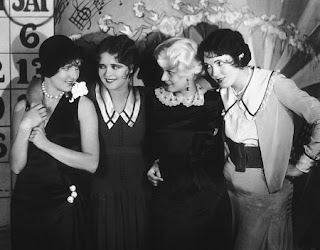
Arthur and her co-stars in a publicity photo for The Saturday Night Kid (1929) one of Arthur's early films.
Left to right: Arthur, Clara Bow, Jean Harlow, Leone Lane.

After years of languishing in sub-par productions and with her career deteriorating, Arthur's contract with Paramount expired in 1931 and was not renewed. Shortly after she was advised to move back to New York, since she presumably no longer had a viable career in Hollywood. Reluctantly, she packed up and went back east, one of many Hollywood washouts.

Broadway Career


Upon returning to New York in 1931, Arthur began to pursue a career on Broadway. While the productions she starred in drew little attention and her Broadway career was generally regarded as a failure, Arthur steadily developed her craft and was positively received by critics. Eventually, this led to her rediscovery by Columbia Pictures, who offered her a contract to return to Hollywood in 1934. Despite her lack of commercial success, Arthur considered her years spent on Broadway to be the happiest of her life.

Columbia Pictures Career


In 1935, Arthur starred in The Whole Town's Talking, her first Hollywood hit. Directed by the legendary John Ford, the film made Arthur into a star and established her screen identity as that of a hard-nosed working girl, the role type that she would be associated with for the rest of her career. Also at this time, Arthur began to bleach her naturally brunette hair a distinctive blonde that would become her iconic look.

Mr. Deeds Goes to Town (1936)


In 1936, director Frank Capra chose Arthur to star alongside Gary Cooper in his next comedy, Mr. Deeds Goes to Town, after Carole Lombard dropped out three days before the start of production. Mr. Deeds was a hit and launched Arthur into superstardom; critics raved over Arthur's performance and the chemistry between she and Cooper.

Cooper and Arthur in Mr. Deeds Goes to Town (1936)

However, during the production of Mr. Deeds, Arthur began to suffer from bouts of stage fright that would plague her for the rest of her career. In fact, Arthur would often become violently ill before shooting and would suffer crying fits between takes. Co-star Cooper stepped in to console Arthur through her anxiety; Arthur appreciated his efforts and would go on name Cooper her favorite co-star.

Later in 1936, Arthur reunited with Cooper to film the swashbuckling western, The Plainsman. The film was a success and Arthur's performance as Calamity Jane was popular with audiences and critics (and was also her favorite role of her career). However, the success of Mr. Deeds and The Plainsman brought another problem for Arthur to the forefront: Her reclusive personality.

During her first years in Hollywood, Arthur's reclusiveness did little to impact her career, as she had yet to accrue a following. However, by the end of 1936 Arthur was a household name, and as such she was expected to give interviews, participate in photo shoots, and attend parties to socialize with the Hollywood elite (like virtually all other major stars of her day). Despite this, Arthur typically declined to appear in public and loathed almost all forms of attention, which somewhat impacted her public appeal and frustrated studio executives.

You Can't Take it With You (1937)


In 1937, Arthur teamed back up with Frank Capra to film the screwball comedy You Can't Take It With You alongside Jimmy Stewart.

Still from You Can't Take it With You (1937)
From left to right: Lionel Barrymore, Jimmy Stewart, Jean Arthur, Edward Arnold.

An adaptation of a Pulitzer Prize-winning play, You Can't Take it With You was met with significant hype. Luckily, the film met expectations and was very well received; in fact, Columbia was so confident in the film that studio executives held a massive press screening prior to its general release, and You Can't Take it With You went on win the Academy Award for Best Picture for 1937. As a result of her run of successful films, Arthur was a finalist to play the coveted role of Scarlett O'Hara in the upcoming production of Gone With the Wind (though the role would famously be awarded to Vivien Leigh).


Only Angels Have Wings (1939)


In 1939, Arthur joined with Cary Grant and director Howard Hawks to film Only Angels Have Wings. Arthur and Hawks clashed during filming, as Arthur was not accustomed to Hawks' highly improvisational style of directing. In addition, Hawks asked Arthur to play her role with more subtlety than she was used to; Arthur unhappily relented and performed her role as directed. Years later, after witnessing Lauren Bacall's performance in another Hawks film (To Have and Have Not), Arthur formally apologized to Hawks, as she finally understood what Hawks was asking of her.

Grant and Arthur in Only Angels Have Wings (1939)


Only Angels Have Wings was also notable for being the debut of future Hollywood star Rita Hayworth. Arthur shunned Hayworth during the production of Only Angles Have Wings, as she saw Hayworth as a threat to her position as Columbia's top actress (a title Hayworth would indeed assume upon Arthur's retirement). Years later, Arthur came to regret her snubbing of Hayworth.

Mr. Smith Goes to Washington (1939)


Later in 1939, Arthur reunited with Capra and Stewart to film Mr. Smith Goes to Washington, another box office success.

Stewart and Arthur in Mr. Smith Goes to Washington (1939)

While originally conceived as a sequel to Mr. Deeds Goes to Town (tentatively titled Mr. Deeds Goes to Washington), Gary Cooper was unavailable at the time, so Jimmy Stewart was chosen for the lead role and the film took shape as Mr. Smith Goes to Washington. Though the movie was a hit, the two stars repeatedly clashed during filming, with Arthur believing that Stewart was playing his role too "cute" and not channeling the "commanding" screen presence that Cooper had embodied. After the conclusion of production, Arthur vowed never to work with Stewart again, even going so far as to pass on the lucrative female role in It's a Wonderful Life simply to avoid Stewart. Despite their differences, Stewart considered Arthur "the finest actress I ever worked with.", and Arthur later considered Mr. Smith Goes to Washington one of her favorite films.

After filming Mr. Smith Goes to Washington, Arthur slowed down the pace of her work considerably. After starring in no fewer than 10 productions from 1936-1939 left her physically and emotionally exhausted, Arthur negotiated an easing of her workload with Columbia to appear in no more than seven pictures over the next five years.

Unfortunately for Arthur, her first three films following Mr. Smith would prove to be unsuccessful. 1940's Too Many Husbands, while moderately successful at the box office, was largely overshadowed by its sister production, Cary Grant's My Favorite Wife. Arizona, also in 1940, attempted to reclaim some of Arthur's fire from The Plainsman, yet it failed spectacularly. 1941's The Devil and Miss Jones (produced by Arthur's then-husband Frank Ross) also underwhelmed.

Despite beginning the 1940s in a slump, Arthur remained quite popular with audiences, and her fortunes would soon turn around.

The Talk of the Town (1942)


Grant, Coleman, and Arthur in The Talk of the Town (1942)

In 1942, Arthur starred alongside Cary Grant and Ronald Coleman in The Talk of the Town. Directed by George Stevens, The Talk of the Town sees Arthur play the role of an innocent schoolteacher caught between a radical political activist (Grant) who is on the run after being accused of arson, and a stuffy law professor (Coleman), who are both vying for her affections. While more of a dramatic comedy (or "dramedy") than the pure screwball comedies that she was best known for, Arthur shined in her role and the film was a hit, performing well at the box office and even earning an Academy Award nomination for Best Picture. Arthur worked particularly well with Stevens, as they had similar approaches to their craft; Arthur would later name Stevens her favorite director.

The More The Merrier (1943)


McCrea, Coburn, and Arthur in The More The Merrier (1943)


After their success together with The Talk of the Town, Arthur and Stevens reunited in 1943 for The More The Merrier, a comedy about a young lady who finds herself unexpectedly sharing an apartment with two men during a housing shortage in Washington, D.C. Co-starring Joel McCrea and Charles Coburn, The More The Merrier was another hit, both commercially and critically. But perhaps most importantly, for her performance in the film, Arthur finally earned her first Academy Award nomination for Best Actress (which she ultimately lost to Jennifer Jones).

The reasons that Arthur had been consistently overlooked by the Academy over the course of her career (in spite of her excellent performances) were varied. Firstly, her best performances were often overshadowed be her co-stars (such as Gary Cooper in Mr. Deeds and Jimmy Stewart in Mr. Smith). In addition, Arthur's best roles were in her comedies, which never fared particularly well with the Academy. And finally, for an actor/actress to win an Oscar, it was expected that his/her resident studio would to quite a bit of politicking on their behalf. Unfortunately, the head of Columbia (Arthur's studio), Harry Cohn, was no fan of Arthur's; the two of them fought titanic battles over contracts and picture assignments (Arthur was quite picky about the films in which she would agree to appear and often rejected assignments, angering Cohn to no end), and as a result, Cohn felt no obligation to appeal to the Academy on her behalf. Nonetheless, modern film historians feel that Arthur's lack of recognition from the Academy is one of the great injustices in Hollywood history.

Retirement


Arthur in Shane (1953), her final (and only color) film appearance

After filming The More The Merrier, Arthur appeared in two more films (A Lady Takes a Chance in 1943 and The Impatient Years in 1944) to fulfill her contract with Columbia (neither film attracted much attention). Eager to leave the pressure and unwelcome attention of Hollywood, Arthur reportedly ran through the studio's streets while exclaiming "I'm free! I'm free!" on the day her contract expired.

While Arthur was convinced to come out of retirement for a couple of one-offs (A Foreign Affair in 1948 and Shane in 1953), the conclusion of her Columbia contract essentially marked the end of her film career. After her retirement from Hollywood, Arthur returned to Broadway for some limited stage work. Aside from a modestly successful production of Peter Pan which ran from 1950-51, Arthur's second stint on Broadway was an utter failure.

In 1966, Arthur attempted a short, ill-fated comeback on TV with The Jean Arthur Show, which was cancelled after 11 episodes. Afterwards, she decided to try her hand at teaching drama at Vassar College, where she instructed a future Hollywood star, Meryl Streep. Though the novelty of having a Hollywood star as an instructor was intriguing for both the school and students alike, clashes between Arthur and the faculty over her teaching style brought her final artistic endeavor to a premature end.

With every meaningful pursuit of her post-Hollywood life having ended in failure, Arthur became as reclusive as ever, retreating to the confines of her Hollywood estate. Arthur later died from heart failure on June 19, 1991 at the age of 90. In accordance with her wishes, no funeral service was held. Arthur's remains were cremated and scattered off the coast of Point Lobos, California.

Legacy


At a time in Hollywood when female roles were reserved largely for either damsels in distress or femme fatales, Arthur's screen presence as a worldly, hard-nosed working girl blazed a trail for the actresses who came after her. In addition, Arthur's up-and-down road to stardom inspired many caught in the dredges of Hollywood's depths to not give up on their dreams.

1935 publicity photo.

At the height of her career, the labels "The Everyday Heroine", "The Quintessential Comedic Leading Lady", and "The Queen of Screwball Comedy" where all ascribed to Arthur. In the years following her retirement, Arthur gradually came to be known as "The Actress Nobody Knew"; her distaste of publicity stood in stark contrast to the attention-hungry culture of Hollywood and much of her personal life was shrouded in mystery (she largely lived as a recluse and had no children). That said, I believe that Arthur's legacy lies not in her reclusion or even her trailblazing career path, but simply in the endearing spirit in which she performed. Whether bringing to life the romance of Mr. Deeds Goes to Town, the comedy of You Can't Take it With You, or the drama of Only Angels Have Wings, Arthur presented a natural charm on the silver screen that is worth remembering.