Showing posts with label History. Show all posts

Tuesday, September 21, 2021

Rocket Ball

When I moved to Huntsville last year, one of the first things I did was research the professional sports scene in town. Being at the height of the initial outbreak of the COVID-19 pandemic, I knew there was little chance I would get to see any pro sports teams play anytime soon, but I wanted to make sure I was well-versed in local sports when the time did come for play to resume. Throughout my studies, I found that Huntsville has a rich (if uneven) history of minor league professional sports, and one that seems to have a bright future.

Let's dig into the history of professional sports in Huntsville.


Baseball

Huntsville Stars (1985-2014)


The Stars are notable for being Huntsville's longest-tenured professional sports team (30 years)

In July 1984, an ownership group led by Larry Schmittou, President of the Southern League's Nashville Sounds, purchased the Evansville Triplets of the American Association. Schmittou essentially planned to swap the locations of the two teams: Send the Sounds to Evansville, Indiana and bring the Triplets down to Nashville. However, after the City of Evansville refused to pay for upgrades to the Triplets' home stadium, Schmittou made an agreement with Huntsville Mayor Joe W. Davis to construct a new, 10,000-seat multipurpose facility (later named "Joe W. Davis Stadium") in Huntsville that would serve as the new home of the Sounds, who would be renamed the Huntsville Stars and begin play as a "new" franchise in 1985. Meanwhile, Schmittou followed through with his plan to move the Triplets to Nashville, where the team assumed the name and history of the Nashville Sounds.

Beginning in 1985, the Stars played 30 seasons in Huntsville, first as an affiliate of the Oakland Athletics (1985-1998) and then the Milwaukee Brewers (1999-2014). During that time, the team fielded a number of future MLB stars (including Ryan Braun, José Canseco, Jason Giambi, Tim Hudson, and Mark McGwire) and won the Southern League championship in 1985, 1994, and 2001.

Just before the 2014 season and after several years of sagging attendance, the Huntsville Stars were purchased by an ownership group led by Ken Young with plans to relocate the team to Biloxi, Mississippi. The plan was to have the Stars play a final "farewell" season in Huntsville in 2014 before moving to Biloxi for the 2015 season and assuming a new identity as the Biloxi Shuckers. However, construction delays with the new stadium meant that for their first 54 games of the 2015 season, the Shuckers played exclusively on the road while the finishing touches were put on their new facility. On June 6, MGM Stadium hosted the Shuckers' home opener, finally completing the move.


Rocket City Trash Pandas (2020-Present)


Huntsville's newest professional sports team and current envy of minor league baseball

In November 2017, an ownership group led by Ralph Nelson purchased the Southern League's Mobile BayBears (who had been struggling with poor attendance and dilapidated facilities) with the intention to relocate the team to Madison, Alabama (a suburb of Huntsville). Following a fan poll, the distinctive name Rocket City Trash Pandas was chosen. 

Toyota Field. I've spent many an evening here

The deal also included the construction of a new, $46 million ballpark in Madison, later named "Toyota Field". While the new stadium was completed and the team's operations were migrated to Madison in time for the start of the 2020 season, the onset of the COVID-19 pandemic delayed and later canceled the season altogether. 

Undeterred, the Trash Pandas began play in 2021 as an affiliate of the Los Angeles Angels. Over the course of their inaugural season, the Trash Pandas led all of Double-A in attendance with an average of over 5,000 fans per game, good enough for 10th overall in minor league baseball.


Basketball

Huntsville Lasers (1991-1992)


The Lasers were the shortest-lived pro sports team to play in Huntsville

In 1991, the Huntsville Lasers were founded as a charter member of the newly formed Global Basketball Association (GBA). The Lasers had a short, tumultuous existence which included the firing of their general manager and publicity manager during the preseason. This disfunction, combined with low attendance and high costs (mostly due to travel), meant the Lasers lasted for only a season and a half, folding along with the GBA in December 1992.


Huntsville Flight (2001-2005)


One of the coolest logos I've seen

In 2001, the Huntsville Flight were formed as a founding member of the new NBA Development League (known today as the G League). The Flight played their home games at the Von Braun Center, and in their third season (2003-04) advanced to the league finals, losing by a mere two points to the Asheville Altitude. 

Unfortunately, the Flight suffered from both low attendance and the NBA Development League's shaky business model, the combination of which forced the Flight to relocate to Albuquerque, New Mexico to become the Albuquerque Thunderbirds following their fourth season in Huntsville. Today, the franchise still exists as the Cleveland Charge.


Football 

Huntsville Rockets (1962-1966)


In 1962, the Huntsville Rockets were formed as a member of the Dixie Professional Football League (DPFL). After one season of play, the Rockets moved to the new Southern Professional Football League (SPFL) where they played for two seasons (1963-1964) before the SPFL folded. Following the demise of the SPFL, the Rockets joined the North American Football League (NAFL) in 1965 where they played a season and a half, folding midway through the 1966 season after failing to pay league dues.


Huntsville/Alabama Hawks (1967-1969)


In 1967, the remnants of the Huntsville Rockets organization came together to form the Huntsville Hawks and joined the Professional Football League of America (PFLA), itself a reorganization of the NAFL. After a single season, the PFLA folded and the Hawks joined the Continental Football League (CoFL), rebranding themselves as the Alabama Hawks. The Hawks played in the CoFL for two seasons before both the team and the league folded.

It's worth noting that during their short existence, the Hawks served as an unofficial "affiliate" of the Atlanta Falcons. Several Hawks players eventually played for the Falcons and the two teams even played an exhibition game in 1969 (which the Falcons won 55-0), one of the rare occasions that an NFL team played a non-NFL team.


Tennessee Valley Vipers (2000-2010)


The Vipers won Huntsville's first pro football championship

In 2000, the Tennessee Valley Vipers were founded as a charter member of the AF2 (stylized as "af2"), the official developmental league of the Arena Football League (AFL). The Vipers played in af2 for five seasons (through 2004) before leaving af2 for a rival league, United Indoor Football (UIF), following a feud between league management and owner Art Clarkson.

This logo needs to go extinct

Upon joining UIF, the Vipers attempted to rename themselves the Tennessee Valley Pythons (as af2 retained ownership of the "Tennessee Valley Vipers" trademark). However, af2 threatened to sue, arguing that since both "Vipers" and "Pythons" referred to snakes, it had the potential to confuse fans. Under legal pressure, the Vipers settled on the name Tennessee Valley Raptors

Unfortunately, fans didn't connect with the team's new identity or the new league's peculiar rules. After playing a single season in the UIF, Raptors owner Art Clarkson relocated the team to Rockford, Illinois where the team once again rebranded as the Rock River Raptors. The team later folded in 2009.

In 2006, after the departure of the Raptors, the af2 founded a new franchise in Huntsville. The new team assumed the name and history of the Tennessee Valley Vipers (which the former team vacated upon leaving af2). The new Vipers played in af2 for four seasons (through 2009) and despite struggles with attendance, the team managed to win the league championship in 2008.

The Vipers' final incarnation

In 2010, the Vipers were moved up to the parent AFL and were renamed the Alabama Vipers. Competing against franchises based in major cities like Dallas, Phoenix, Orlando, and Cleveland, the Vipers played only one season in the Huntsville before relocating to Atlanta and rebranding as the Georgia Force. The franchise later folded in 2012.


Alabama Hammers (2011-2015)


Reminds me of my alma mater, Southern Miss

In 2011, following the departure of the Alabama Vipers to Georgia, a new ownership group stepped in the fill the void by founding the Alabama Hammers as an expansion franchise in the Southern Indoor Football League (SIFL). Named after the Alabama state bird (the Yellowhammer), the Hammers played in the SIFL for one season before the league, plagued by financial instability, folded.

In 2012, the Hammers joined the Professional Indoor Football League (PIFL) where they played for four seasons, winning the league championship in 2013. After the 2015 season, both the Hammers and the PIFL folded.


Hockey

Huntsville Blast (1993-1994)


Huntsville was just a pit stop for the Blast

In 1993, the Roanoke Valley Rampage of the East Coast Hockey League (ECHL) relocated to Huntsville and became the Huntsville Blast. The Blast played a single season in Huntsville (1993-94), averaging barely 1,500 fans per game before being sold and relocated to Tallahassee, Florida to become the Tallahassee Tiger Sharks. The organization still exists today as the Utah Grizzlies.


Huntsville Channel Cats (1995-2004)


The Channel Cats won a championship in each league in which they played

In 1995, the Huntsville Channel Cats were founded as an expansion franchise for the Southern Hockey League (SHL) by Knoxville, Tennessee-based doctors John Minchey and John Staley. In their first and only season in the SHL, the Channel Cats won the league championship before the SHL folded after the 1995-96 season.

In 1996, following the demise of the SHL, the Channel Cats joined the Central Hockey League (CHL) for the 1996-97 season. The Channel Cats played a total of five seasons in the CHL (through the 2000-01 season), winning the league championship in the 1998-99 season.

After Minchey and Staley threatened to move the team following the 1998-99 season, the Channel Cats were sold to a local businessman, John Cherney. Cherney disliked the nickname "Channel Cats" and changed the team's moniker to the Huntsville Tornado beginning with the 2000-01 season, an unpopular move with fans. A combination of poor attendance and date conflicts with the Huntsville Flight and UAH Chargers led the organization to suspend operations for the next two seasons.

The team played as the Huntsville Tornado for one season (2000-01) before temporarily suspending operations

In 2003, Cherney helped found a new league called the South East Hockey League (SEHL) and revived team operations with the name returning to the Huntsville Channel Cats following a fan poll. The Channel Cats played in the SEHL for the 2003-04 season, winning the league championship before the league folded.

Following the demise of the SEHL in 2004, a plan was formulated to combine the remnants of the SEHL with that of the WHA2 (World Hockey Association 2, another defunct hockey league) to form a new league, the Southern Professional Hockey League (SPHL). 

At the same time, a new ownership group proposed starting a new professional hockey team in Huntsville to join the SPHL in place of the Channel Cats. Ultimately, the decision on whether the Huntsville Channel Cats would survive as an SPHL franchise or if the new proposed team would replace them fell squarely on the venue, the Von Braun Center.

In the end, the Von Braun Center selected the new ownership group's franchise as their new tenant, which was soon christened the Huntsville Havoc. The Channel Cats folded immediately following the Center's decision.


Huntsville Havoc (2004-Present)


The Havoc are one of the SPHL's more successful franchises

In 2004, the Huntsville Havoc began play as a founding member of the SPHL. To date, the Havoc have played 17 seasons in the SPHL and won the league championship in the 2009-10, 2017-18, and 2018-19 seasons. Furthermore, the Havoc have regularly led the SPHL in attendance and are considered one of the league's most stable franchises.


Soccer

Huntsville Fire (1997-1998)


The name was appropriate, considering the circumstances

In 1997, the Daytona Beach Speedkings were founded as a charter member of the Eastern Indoor Soccer League (EISL). Due to dismal attendance (selling fewer than 200 tickets per game), the team was sold and relocated just 8 games into the season, arriving in Huntsville in in July 1997 as the Huntsville Fire.

Upon the team's arrival in Huntsville, attendance increased to about 2,500 per game and this number held steady through the team's second season in 1998. However, it wasn't enough to save the franchise or the league; the former suspended operations in September 1998 and the latter folded in December. 


Future

I know that the history of professional sports in Huntsville consists of more misses than hits, but that's the nature of minor league sports. However, the success of the Huntsville Havoc and Rocket City Trash Pandas (as well as the Huntsville Stars, who stayed around for 30 years before eventually moving) shows that with the right combination of ownership, venue, and fan engagement, professional sports franchises in Huntsville (and anywhere, really) can survive and thrive.

In the years since teams like the Flight, Hammers, and Fire have come and gone, Huntsville has experienced an incredible amount of growth. A generation of young, educated, affluent professionals has reshaped the area, and I think they're hungry for local sports that they can identify with.

Rendering of the proposed renovation of Joe Davis Stadium

A more tangible sign of hope may be the recent plan to renovate Joe W. Davis Stadium and turn it into a multi-purpose sports facility with the aim of attracting a minor league soccer team. I know this is a bit of a "down the road" scenario, but hey, if Huntsville keeps growing, why not? Given Huntsville's current trajectory, I don't see why this city can't be place where professional sports can thrive.

Friday, December 18, 2020

The Strange Case of the ERA

Constitutional amendments have a checkered history in American politics. Some are upheld as the most important and sacred pieces of our law, others are obscure, and one was even repealed. However, perhaps no case is as strange (or controversial) as one particular proposed constitutional amendment called the Equal Rights Amendment (ERA).

In this post, I'll discuss the history of the ERA, what derailed its once-promising ratification effort, and where the amendment stands today.

Let's examine the strange case of the ERA.


Background

The idea of a constitutional amendment that explicitly guaranteed equal legal rights for men and women has been kicked around in one form or another since at least the 1920s. With the passage of the Nineteenth Amendment in 1920, women won the right to vote in the United States, and immediately discussion began brewing that it didn't go far enough: An additional amendment was needed to guarantee women equal rights in all legal matters.

Over the next few decades, support for such an amendment gradually began to build. Similar amendments were introduced in every congressional session between 1921 and 1972, typically being defeated in committee each time. Various political interest groups and labor unions discussed, debated, and fought amongst each other over the issue, disagreeing about whether it would actually benefit women and/or the country as a whole and whether it was even needed. 

Rep. Martha W. Griffiths (D-MI), who introduced the ERA in 1971 and is often called "the mother of the Equal Rights Amendment".


However, the turning point came in the 1960s where, like in the 1920s, support for an equal rights amendment was fueled by the passage of another law, this time the Civil Rights Act. Finally, in October 1971, with the backing of numerous women's interest groups and labor unions, the ERA as we know it today was approved by the United States House of Representatives by a vote of 354-24 (with 51 not voting). This was soon followed by the passage of the ERA in the United States Senate in March 1972 by a vote of 84-8 (with 7 not voting). President Richard Nixon then immediately endorsed the ERA upon its passage by Congress.

With overwhelming bipartisan support in both houses of Congress and an endorsement by the President, the road to ratification for the ERA seemed clear.

Or was it?


Road to Ratification

For a constitutional amendment to be ratified, it not only needs to be approved by Congress, but also ratified by a 2/3 majority of state legislatures. Beginning with its passage by the Senate in March 1972, the ERA was placed in the hands of the states with a seven-year deadline (March 22, 1979) for 38 states to ratify it.

By the end of the month, 8 states had ratified the ERA, and by the end of April that number was up to 16. Another 4 ratified by the end of 1972, bringing the total up to 22, and another 8 ratified by the end of March 1973 for a total of 30 of the required 38 ratifications.

However, after the 30th ratification, momentum began to ebb. Despite gaining 30 ratifications in its first year, the ERA managed to acquire only 5 more ratifications over the next 4 years, bringing to total up to 35, three short of the 38 required. To add to the ERA's woes, three of the states that had originally ratified the ERA had since voted to rescind their ratification (more on that later).

By the time the ratification deadline hit in March 1979, no additional states had voted to ratify the ERA, and two more had voted to rescind their ratification (Congress attempted to extend the deadline by 3 years to June 30, 1982, but this extension was struck down by the Supreme Court in NOW v. Idaho, a decision which also upheld state rescission). At that time, the ERA, an amendment seemingly destined for ratification with broad political support, was all but dead in the water.

How did this happen? Why did states stop ratifying the ERA while others actually voted to rescind their ratification? It turns out, support for the ERA was far from unanimous.


Opposition

Though small in number, there were influential groups and individuals (even women) who opposed the ERA from the beginning.

Phyllis Schlafly, a conservative activist from Illinois who campaigned against the ERA


Conservative activists, such as Phyllis Schlafly of Illinois, argued that depending on how the ERA was interpreted, women could stand to lose legal advantages that they currently enjoyed over men, including preference in regard to alimony and child custody in divorce cases, as well as exemption from the draft. Furthermore, it was argued that with the passage of the Equal Pay Act in 1963 and the Civil Rights Act in 1964, there were no remaining practical legal advantages to be gained for women by the passage of the ERA.

The campaign against the ERA was particularly effective. By 1973, public support for the ERA in states that had yet to ratify fell below 50%, as large numbers of working-class women turned against the amendment. Additionally, by the ratification deadline in 1979, a total of five states that had ratified the ERA voted to rescind their ratification.

At the 1980 Republican National Convention, the Republican Party officially dropped support for the ERA from the party platform. Since bipartisan support is a virtual necessity for the ratification of any constitutional amendment, the RNC's decision to oppose the ERA was effectively the death knell for the ratification effort.


The ERA Today

In the years since the ERA's defeat, there has been an ongoing effort by the amendment's supporters to revive the ratification campaign. These supporters argue that 

  1. Congress can retroactively remove the ratification deadline and, provided an additional three states vote to ratify the ERA, it can still become law
  2. Because the Constitution specifies no mechanism for states to rescind amendment ratification, the rescissions of the 5 states that did so are null and void (contrary to the Supreme Court's ruling in NOW v. Idaho).

Map of where states stand on ERA ratification.
Pink = Ratified
Purple = Ratified after deadline
Orange = Ratified, but then rescinded
Green = Partially ratified
Blue = Not ratified


Since 1979, three additional states (Nevada, Illinois, and Virginia) have voted to ratify the ERA. Additionally, numerous bills have been introduced in Congress to remove the ratification deadline, the most recent of which passed in the House of Representatives in 2020 by a vote of 232-183 (it has yet to be introduced in the Senate).

However, even if the ratification deadline is removed, 5 states voted to rescind their ratification, which would bring the running total of state ratifications back down to 33. Debate over whether these rescissions are valid has raged for years, despite the ruling in NOW v. Idaho. Even many ERA supporters admit that if Congress is allowed to retroactively change the rules for ratification, it only makes sense for the decision of the states who changed their position on ratification be respected.

Among those who held this view was the late liberal Supreme Court justice Ruth Bader Ginsburg, who suggested that supporters of the ERA would be better off by starting the effort over from scratch rather than trying to ride on the coattails of the 1972 bill. Ginsburg said that "If you count a latecomer on the plus side, how can you disregard states that said 'We've changed our minds?'".


My Take

Personally, I question the need for the ERA. Virtually every practical legal protection women can ask for is already enshrined in law in one way or another (especially in the context of the Civil Rights Act), meaning that the ERA would be more symbolic than anything.

Furthermore, I agree with the late Justice Ginsberg that proponents would be better off starting anew. If you're going to retroactively change the rules regarding ratification, then you need to allow states to retroactively change their votes.

After all, fair is fair.

Wednesday, November 25, 2020

East Asia Squadron - Part II: The Battle of the Falkland Islands

Sailing against the odds, the German East Asia Squadron made it from their base in China across the Pacific to neutral Chile. There, they inflicted upon Great Britain its first naval defeat in over 100 years.

However, the tide was still against East Asia Squadron, as the British were not going to take the defeat lying down. The fate of East Asia Squadron would be decided in the next showdown with the British fleet: The Battle of the Falkland Islands.


Background

On November 3, 1914, three of East Asia Squadron's cruisers (SMS Scharnhorst, SMS Gneisenau, and SMS Nürnberg) entered Valparaíso harbor, where they were welcomed by the local German-speaking population. 

However, the squadron's commander, Maximillian von Spee, was in no mood for revelry. Despite his resounding victory over the British squadron sent to destroy him two days earlier, he was still pessimistic about his chances of making it back to Germany alive. When presented with a bouquet of flowers by the grateful German people, he declined them, commenting that "these will do nicely for my grave".


SMS Scharnhorst, flagship of East Asia Squadron


After leaving Valparaíso the next day, East Asia Squadron received two pieces of bad news. First, one of their cruisers, the SMS Emden, which had recently been sent to the Indian Ocean on a commerce raiding mission, had been caught by the Australian Royal Navy and destroyed. Second, East Asia Squadron's home port in Qingdao, China, had fallen to the Japanese.

Spee and his officers soon met to discuss what to do next. Most of the officers still wanted to make a run to Germany, but their ships were low on ammunition and badly in need of maintenance following the Battle of Coronel. Spee agreed, but he insisted (against the objections of his captains) on first raiding the British fueling base at Stanley harbor in the Falkland Islands before setting sail for Germany.

Vice Admiral Doveton Sturdee, commander of the second British naval squadron sent to destroy East Asia Squadron

Meanwhile, the British were organizing their response to the defeat at Coronel. Having recovered from the initial shock of the loss, the British Admiralty dispatched the battlecruisers HMS Invincible and HMS Inflexible, two of the most advanced combat ships in the world, to the Falkland Islands under the command of Vice Admiral Doveton Sturdee. There, they met up with other British cruisers, giving Sturdee a formidable complement of warships:

- HMS Invincible (flagship)

- HMS Inflexible

- HMS Glasgow (survivor of the Battle of Coronel)

- HMS Bristol

- HMS Cornwall

- HMS Kent

- HMS Macedonia

- HMS Carnarvon

Additionally, HMS Canopus, an outdated battleship that had been a part of Vice Admiral Cradock's squadron but had not participated at the Battle of Coronel due to mechanical issues, was beached at Stanley harbor to be used as a makeshift shore defense battery while the rest of the squadron laid in wait in the harbor.

Once the battle group was assembled, British Intelligence cryptographers sent out a fake signal which indicated that Stanley harbor was devoid of any armed British naval presence, suggesting the base was defenseless. It was this signal that convinced Spee that Stanley harbor was a prime target to raid, essentially serving as bait that would lure East Asia Squadron into a British trap.


The Battle of the Falkland Islands

On December 8, Spee made his move. That morning, he sent two of his cruisers, Gneisenau and Nürnberg, to approach Stanley harbor. Spee had no idea about the presence of Sturdee's squadron in the harbor, which was at anchor at that time and not expecting combat.

German map of the Battle of the Falkland Islands


While East Asia Squadron had caught the British fleet unprepared, it was an encounter that the Germans were not expecting, and Spee's cruisers soon received fire from an surprising source: The beached Canopus. This unanticipated resistance gave the German cruisers pause and kept them at bay while Sturdee's squadron prepared for battle.

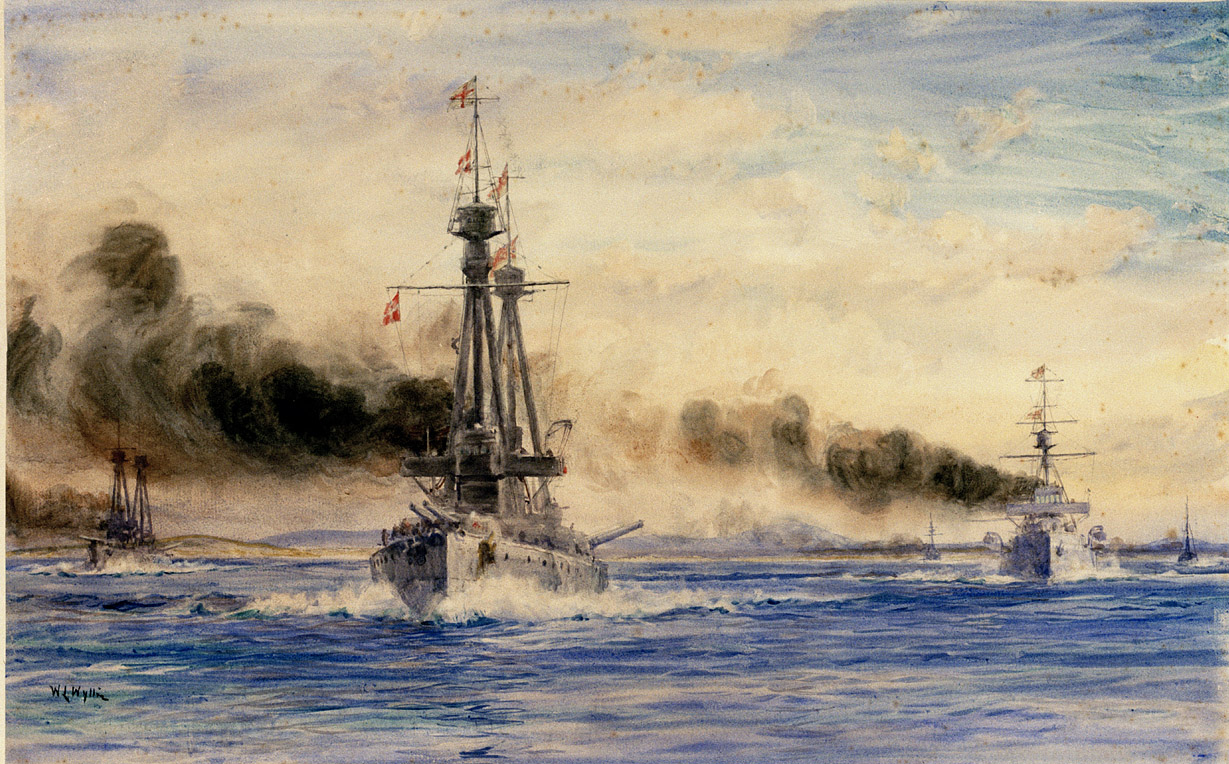
Once Spee realized that he was outnumbered 7-5 in terms of main warships (including two British battlecruisers, the most powerful warships afloat at the time), he ordered his force to make a desperate dash out into the open ocean, where he hoped to lose the British ships. Unfortunately for East Asia Squadron, not only were the British ships faster, but the seas were calm and it was still morning, giving them plenty of daylight to work with. At 10:00, the British fleet left port and gave chase.

The Invincible and Inflexible give chase. Painting by William Lionel Wyllie.


At 1:00, the Invincible and Inflexible opened fire on East Asia Squadron. Realizing he couldn't outrun the British, at 1:20 Spee ordered Scharnhorst (his flagship) and Gneisenau to turn and fight, in an effort to give the other ships an opportunity to escape.

Scharnhorst and Gneisenau proceeded to exchange fire with Invincible and Inflexible. At first, the German ships managed to land several hits on Invincible, but the damage was minimal. Before long, the British battlecruisers began striking major blows against their German adversaries. The East Asia Squadron flagship Scharnhorst sustained several hard hits and began to list heavily at 4:04. At 4:17, she sank with all hands, including Spee. Gneisenau continued to fight on until her ammunition ran out at 5:15. Sturdee ordered a cease fire at 5:50, and the Gneisenau's crew allowed her to sink at 6:02, of which 190 were rescued by the British.

The Scharnhorst sinks while the Gneisenau fights on. Painting by William Lionel Wyllie.


Meanwhile, Sturdee dispatched Kent to run down Nürnberg, and Glasgow and Cornwall were sent to chase Leipzig. At 5:00, the Kent caught the Nürnberg, at which point the Nürnberg turned to fight (the slower Cornwall lagged behind). The two ships exchanged fire until 6:35, when the Nürnberg sustained so much damage she could no longer fire. The Nürnberg sank at 7:26; only twelve of her crew were rescued by the Kent.

Earlier, at 2:40, Glasgow caught up to the Leipzig and began firing. Leipzig responded with fire of her own, and both ships were damaged. Glasgow temporarily retreated, regrouping with Cornwall and Kent before re-engaging Leipzig. Leipzig fought on until 7:20, at which point the captain ordered the crew to scuttle the ship. At 9:05, Leipzig sank; only eighteen men were rescued. The Battle of the Falkland Islands was over.

The Inflexible rescues survivors from the Gneisenau

Like the Battle of Coronel, the outcome of the Battle of the Falkland Islands was disproportionate. East Asia Squadron lost 4 of 5 cruisers and 2,086 men (1,871 killed, 215 captured). Meanwhile, the British lost no ships and suffered only 29 casualties (10 killed, 19 wounded).


The Battle of Más a Tierra

Of the five cruisers of East Asia Squadron, only the Dresden successfully evaded the pursuing British ships and escaped destruction. The Dresden would remain at large until March 14, 1915, when she was cornered by the Glasgow, Kent, and Orama at Cumberland Bay, Chile. 

In the short Battle of Más a Tierra, the Dresden briefly exchanged fire with her pursuers before the crew scuttled her and escaped to shore, where they would spend the rest of the war in Chilean captivity. Such was the end of East Asia Squadron.

The Dresden, pictured here in Cumberland Bay just before her crew scuttled her. Note the white flag flying on the foremast.


Interestingly, the Dresden and the Glasgow were the only two ships to take part in all three battles of the East Asia Squadron campaign, with the Glasgow being the only ship to survive all three engagements.


Aftermath

With the destruction of East Asia Squadron, Germany no longer possessed any major overseas naval forces. From that point on, direct naval action between German and Allied warships would be restricted to the waters around Europe.

Following his victory in the Battle of the Falkland Islands, Sturdee quickly rose through the ranks of the British Admiralty, becoming a full Admiral on May 17, 1917. He would command his own squadron at the Battle of Jutland (the largest naval battle of World War I) and retire as Admiral of the Fleet on July 5, 1921.

Scan-generated image of the SMS Scharnhorst wreck. Note that the barrels on the forward turret are fully elevated, indicating she was firing as maximum range when she sank.


On December 9, 2019, the wreck of the Scharnhorst was discovered, resting about 98 miles southeast of Stanley at a depth of 5,280 feet.


My Take

The story of East Asia Squadron is an interesting one to me. This motley collection of warships, cut off and half a world away from their home, nearly made it all the way back, inflicting a major defeat upon the world's most powerful navy (the first in over 100 years) along the way. Had it not been for Spee's single mistake of choosing to raid the Falkland Islands instead of sailing straight to Germany, East Asia Squadron may have done the impossible and made it all the way back to home.

That, I believe, is worth remembering.

Wednesday, November 18, 2020

East Asia Squadron - Part I: The Battle of Coronel

In the discussion of World War I's naval battles, much is said about the sinking of the Lusitania, the massive Battle of Jutland, and the emergence of submarine warfare. However, one often overlooked chapter involves the German overseas fleet, the East Asia Squadron.

The story of the East Asia Squadron is a remarkable one. It was this motley collection of cruisers that scored what was perhaps Germany's greatest naval victory of the war, one that was started by a chance encounter in a remote, neutral harbor.

Let's review the story of the East Asia Squadron and the Battle of Coronel.

East Asia Squadron in harbor at Valparaíso, Chile


Background

At the outbreak of World War I, the British Royal Navy was by far the largest and most advanced navy in the world. However, Germany had been making strides to catch up (as part of the Anglo-German naval arms race), and the German fleet stood as the first real challenge to British naval superiority since the Napoleonic Wars.

However, the vast majority of the German Fleet was based in the North Sea, between Germany and Britain. As a result, Germany had few naval vessels stationed elsewhere around the globe, and those were mostly older, outdated vessels that were no match for modern British battleships. The one exception was Germany's East Asia Squadron.


Outbreak of World War I

Germany's only major overseas naval force, the East Asia Squadron was formed in 1881 to protect German interests in Asia. Based in Qingdao, China, the East Asia Squadron consisted of five major warships at the outbreak of World War I: 

- SMS Scharnhorst (flagship)

- SMS Gneisenau

- SMS Emden

- SMS Leipzig

- SMS Nürnberg

Accompanying these ships were numerous smaller gunboats and support auxiliaries.

Vice Admiral Maximilian von Spee, commander of East Asia Squadron


When war broke out in August 1914, the East Asia Squadron, commanded by Vice Admiral Maximilian von Spee, found himself outnumbered and outgunned by the Allied navies in the region. Caught squarely between the Japanese and Australian navies, Spee and the German High Command believed that the East Asia Squadron would be quickly destroyed if they stayed in the Pacific. As a result, Spee decided to make a run home for Germany, though he knew the odds were against him.


Race Across the Pacific

Spee decided to cross the Pacific (where the vastness of the ocean would protect him from Allied naval forces) to neutral Chile and then round Cape Horn (the southernmost tip of South America) into the Atlantic. From there, he would fight his way north up the Atlantic to Germany. 

In October 1914, East Asia Squadron made it across the Pacific to Chile, where they met up with the German cruiser SMS Dresden, bringing the squadron's total number to major warships to six.

Rear Admiral Sir Christopher Cradock, commander of the Royal Navy's South American Station


That same month, the British learned of Spee's plan. In response, the British Admiralty assigned Rear Admiral Sir Christopher Cradock and his naval squadron (based in the Falkland Islands, just to the east of Cape Horn) to search the west coast of Chile for the East Asia Squadron.

Cradock's squadron consisted of four cruisers:

- HMS Good Hope (flagship)

- HMS Monmouth

- HMS Glasgow

- HMS Otranto

Unfortunately for the British, Cradock's squadron, consisting of outdated ships and inexperienced crews, was outmatched by East Asia Squadron. Furthermore, there was a misunderstanding regarding Cradock's orders: Cradock believed that his orders were to locate and engage East Asia Squadron, while the British Admiralty only wanted him to locate East Asia Squadron and engage only if the situation was advantageous.

Since Chile was neutral in World War I, both sides used Chilean ports to refuel and to collect mail, though they were permitted to stay in harbor no longer than 24 hours. On October 31, while searching for East Asia Squadron along the west coast of Chile, Cradock sent one of his cruisers, the Glasgow, into Coronel harbor to collect mail from the British consul. 

By chance, also in the harbor was the SMS Göttingen, one of East Asia Squadron's supply ships. Upon sighting one another, both the Glasgow and the Göttingen radioed to their respective fleets. Soon, both naval squadrons were racing to Coronel.

The next morning, the Glasgow left Coronel harbor and rejoined Cradock and the rest of the fleet. At 4:17 that afternoon, both squadrons sighted one another. The Battle of Coronel had begun.


The Battle of Coronel

North of Coronel, five cruisers of East Asia Squadron were arrayed against the four cruisers of Cradock's squadron, located south of Coronel (one German cruiser, the Nürnberg, was delayed and would not arrive until late in the battle). Immediately realizing that he was overmatched, Cradock faced a choice: He could take his three faster cruisers (Good HopeMonmouth, and Glasgow) and make a run for it while his slower cruiser, Otranto, fought a delaying action, or he could stand and fight with his full force.


Relief map of the Battle of Coronel


At 5:10, Cradock chose the latter, drawing his ships in close for what he believed to be his last stand. The newer ships of East Asia Squadron had, on average, superior range to the British guns, and could better handle the rough seas in which the battle was fought. Initially, Cradock attempted to compensate for this disadvantage by quickly closing into firing range with East Asia Squadron. However, Spee kept his distance, staying just out of range of Cradock's ships. When the sun set at 6:50, Spee finally decided to engage and closed in on Cradock's squadron before opening fire.


HMS Good Hope, Cradock's flagship


Five minutes after the Germans ships began firing, Cradock's flagship, the Good Hope, was hit. Soon after, the Otranto, being poorly suited for such an engagement, retreated at full speed. As the ships continued to maneuver into position, it was the Good Hope and the Monmouth facing off against the Scharnhorst, Gneisenau, and Emden, while the Glasgow engaged the Leipzig and Dresden.

SMS Scharnhorst, Spee's flagship


Now under fire, Cradock tried once again to close on East Asia Squadron. By 7:30 he had gotten his ships within range, but the German fire became more accurate; both the Good Hope and the Monmouth were hit several times. 

By the time darkness fell, both Good Hope and Monmouth were on fire, presenting easy targets for the German gunners, who proceeded to score more direct hits. By 7:50, Good Hope and the Monmouth, both heavily damaged, had stopped firing. At 7:57, the Good Hope exploded and sank, lost with all hands.

Meanwhile, the Gneisenau moved to join the Leipzig and Dresden, who were engaging the Glasgow. The Glasgow suffered several minor hits, while inflicting none. At 8:05, realizing the situation was hopeless, the Glasgow broke off the engagement and went to render assistance to the wounded Monmouth. However, upon arriving, it was determined that there was nothing the smaller Glasgow could do for the sinking Monmouth. The Glasgow then retreated south.

Later that night, the Germans conducted a search for the Monmouth, which they had lost track of in the darkness. Eventually, she was found by the cruiser Nürnberg (which had finally joined the battle). The Monmouth was extended an invitation to surrender, which she refused. The German ships then proceeded to open fire, sinking her at 9:18. Almost exactly five hours after the fleets had sighted one another, The Battle of Coronel was over.


Aftermath

As a result of the battle, the British had lost two cruisers, the Good Hope (Cradock's flagship) and the Monmouth. Both ships were lost with all hands, totaling about 1,600 officers and men, Admiral Cradock among them. Both the Glasgow and the Otranto escaped. The Germans, on the other hand, suffered only three wounded and light battle damage.


The Battle of Coronel by Hans Bohrdt


The victory of East Asia Squadron over Cradock sent shockwaves through both the British Admiralty and the general public, as it was Britain's first naval defeat in over 100 years (The Battle of Plattsburgh in the War of 1812). With the victory at Coronel, it seemed as if Spee's plan to escape to Germany with East Asia Squadron just might work after all.

However, despite this defeat, the British had no plans on letting East Asia Squadron make it back to German waters. Read the conclusion of the story in my next blog post, East Asia Squadron Part II: The Battle of the Falkland Islands.

Tuesday, November 10, 2020

537

Elections are no strangers to controversy. However, perhaps no election in recent history was as controversial as the 2000 United States Presidential election. Decided by a margin so small it defies belief, this election (and the controversy surrounding it) still stirs up debate and consternation to this day.

Let's get to the bottom of what happened in that election.

Let's revisit the recount controversy of the 2000 United States Presidential Election.


Election Night


On November 7, the night of the 2000 Presidential Election between Vice President Al Gore (D) and Texas Gov. George W. Bush (R), Florida was a closely-contested state: Final polls leading up to the election had Gore leading Bush between 2-4 percentage points, within the margin of error. 

County vote map of Florida from the 2000 Presidential Election

Soon after the polls closed in the Florida peninsula (which is in the Eastern time zone), the Associated Press called the state for Gore (based on result tallies and exit polling). However, as results continued to come in throughout the night (especially from the Florida panhandle counties in the Central time zone), the margin began to tighten. Several news networks proceeded to reverse their call, moving from "Gore" to "too close to call".

By the end of the evening, it became apparent that the winner of Florida would be the next President of the United States. At the end of the election-night vote count, Bush led in Florida by 1,784 votes. Under Florida state law, the small margin initiated an automatic statewide machine recount.


The Recount(s)


The recount was completed on November 10, after which Bush's lead was reduced to 327 votes. Following the recount, the Gore campaign requested a manual recount in four counties: Miami-Dade, Broward, Palm Beach, and Volusia.

The Florida Supreme Court building, where much of the drama played out


Under Florida state law, when a candidate requests a recount in a particular county, it is up to the county to decide whether to approve or deny the request. In response to the Gore campaign's request, Volusia began a recount on November 12. However, state law also required that all counties report and certify their returns by 5:00 PM on November 14. This was a problem, as manual recounts were very slow. Thus, there was a very real danger that the recount would not be complete by the deadline.

By November 14, Volusia had completed its recount, after which Bush held a 300-vote lead. Palm Beach had decided to perform a recount, but had not yet started, while Broward and Miami-Dade were still considering the Gore campaign's request. However, with the deadline past and the recounts in Palm Beach, Broward, and Miami-Dade counties having not yet started, it was up to the courts to decide whether the recounts in those counties could be included in the final tally.

Over the next few days, the courts ultimately decided that the recounts could continue, but that the Florida Secretary of State, Katherine Harris, could refuse to allow subsequent recounts to be included in the final tally. However, this ruling was put on hold while the Florida Supreme Court considered an appeal by the Gore campaign. Meanwhile, recounts began in Palm Beach, Broward and Miami-Dade counties.

On November 21, in response to the Gore campaign's appeal, the Florida Supreme Court ruled that ongoing recounts in Palm Beach, Broward, and Miami-Dade counties must be included in the final tally and gave the counties until November 26 to complete them. The next day, Miami-Dade County suspended its recount, saying it didn't have enough time to complete it before the deadline (the Gore campaign unsuccessfully sued Miami-Dade County to continue its recount).

By November 26, the recounts in Palm Beach and Miami-Dade counties were still incomplete. At that time, Harris proceeded to certify the statewide vote count as it stood then, which gave Bush the win in Florida by a margin of 537 votes.

On December 8, in a surprise ruling, the Florida Supreme Court ruled against the use of a manual recount in just the four counties that the Gore campaign had requested and instead ordered a statewide manual recount of all "undervotes" (ballots where no vote for President was recorded). This recount had the potential to alter the outcome of the election, as about 45,000 ballots were classified as "undervotes".

However, the next day, in response to an appeal by the Bush campaign, the US Supreme Court overruled state court's decision, ordering that the recount be halted and that the results certified on November 26 should stand as the final tally.

On December 13, in a nationally-televised address, Gore officially conceded the election to Bush.


My Take


In the years since the election, it has been debated as to whether Bush or Gore really "won" Florida. Some say that because Bush was the official leader at end of the election night count and at the end of each subsequent recount, he was the undisputed winner of the state of Florida. However, others point out that the manual recounts of Palm Beach and Miami-Dade counties (which were very friendly to Gore) were never completed, and that Gore would have likely won if they were.

The infamous "Butterfly Ballot", which the Gore campaign claimed caused many voters to accidentally vote for Pat Buchanan

Additionally, it's become a common misconception that the US Supreme Court "overturned" the result of the election in Florida, giving it to Bush when it was "rightfully" won by Gore. However, as you can see from this timeline, that is not what happened at all. The Supreme Court simply ended the "undervote" recount, allowing the results certified on November 26 to stand as the final tally.

Personally, I approach this like a filmmaker. When you're a director trying to get the perfect shot, you may find it or you may not. However, what you can't do is spend too much time searching for it. Eventually, you've got to take what you have, perfect or not, and move on. Otherwise, the movie won't be finished.

In the election in Florida, we could have spent weeks or months performing recount after recount with the final tally changing each time. However, certification deadlines exist for a reason. At a certain point, you've got to declare a winner and move on. You can only reasonably count votes so many times.

In this instance, we had four different counts:

The election night count (Bush won +1,784)

The machine recount (Bush won +327)

The Volusia recount (Bush won +300)

The Broward recount (Bush won +537)

In most elections, there is only one count before a winner is declared. In 2000, Florida got four, with the same winner each time. I know the margin is close, but after four counts, it's time to move on. Besides, by all rights, the winner should have been declared on November 14, the original deadline. It was a courtesy to the Gore campaign that it was extended to November 26, at which point Bush still won.

Over the years, the vote count in Florida has been debated ad nauseum, but it's all purely academic. After all, Monday morning quarterbacks don't win games.

Wednesday, November 4, 2020

The Killian Documents

The 2020 Presidential election is upon us and, as expected, controversy has ensued. However, rather than focus on this election, I would like to revisit a controversy from a past election, an affair that rocked the 2004 Presidential race and effectively ended the career of one of the most celebrated names in news journalism.

Let's revisit the Killian Documents.


1st Lt. George W. Bush in the Texas Air National Guard (TexANG).

Background


In August 2004 (three months before the 2004 Presidential election), Lt. Col. Bill Burkett, a former US Army National Guard officer, made contact with CBS News producer Mary Mapes, claiming to have documents proving that President George W. Bush received improper treatment during his time in the Texas Air National Guard (TexANG).

The documents were memos supposedly written in 1973 by Bush's then-commanding officer, the late Lt. Col. Jerry B. Killian. They claimed that Bush had disobeyed orders and that outside influence had been exerted on his behalf to improve his record. Burkett claimed that he obtained the documents from Killian's personal files via a former TexANG Warrant Officer.

Burkett had previously made multiple unsubstantiated allegations against Bush, one of which he later retracted. This led to many media outlets considering him an 'anti-Bush zealot' and an unreliable source.

In early September, Burkett provided photocopies of the documents to Mapes. Mapes informed CBS News anchor Dan Rather of the story and together they planned to air it on September 8.


CBS Investigation


Before airing the story, CBS conducted an investigation to determine if the documents were authentic. This investigation consisted of two interviews with individuals who knew Killian and an analysis of the documents by four forensic experts.

Both interviewees, Robert Strong (Killian's friend and head of the TexANG administrative office) and General Robert Hodges (Killian's immediate superior at the time), maintained that the documents could have been legitimate based on their content, but they had no first-hand knowledge that could verify their authenticity.

Opinion was split among the document experts. Two said that the documents had outstanding issues that called their authenticity into question, while the other two experts cautiously believed that the documents were authentic based on the document signatures.


Breaking the Story


Despite the mixed findings from the investigation, Mapes and Rather decided to push forward with breaking the story on September 8.

Immediately after the story was aired, several bloggers began discussing and analyzing the documents. By the next day, claims that the documents were forgeries had spread across the internet.

Animated GIF comparing one of the documents to a copy made in Microsoft Word

On the night of September 9, CBS News released a statement saying that the documents were "thoroughly investigated by independent experts, and we are convinced of their authenticity" and "this report was not based solely on recovered documents, but rather on a preponderance of evidence, including documents that were provided by unimpeachable sources", though the latter claim was soon dropped.

By September 10, other news outlets such as The Washington Post, The New York Times, and the Associated Press were openly questioning the documents. The Dallas Morning News pointed out that one of the officers mentioned in one of the documents was discharged a year and a half before the document was supposedly written.

Nevertheless, CBS News continued to defend the authenticity of the documents.


CBS's Defense


Media coverage of the story intensified daily. CBS attempted to have additional experts verify the authenticity of the documents, but the results continued to be inconclusive.

Meanwhile, the original document examiners began to speak publicly. The two who had expressed doubts to CBS about the documents continued to do so, while the other two stated that they had only been asked to verify the signatures on the documents, not the documents themselves.

On September 15, CBS interviewed Killian's former secretary, Marian Knox. During the interview, Knox made contradictory statements about whether she believed in the authenticity of the documents themselves and the information they contained.

The next day, September 16, Rather acknowledged that the documents could be fake, stating: "If the documents are not what we were led to believe, I'd like to break that story."


CBS Apologizes


On September 20, CBS reported that their source, Bill Burkett, admitted that he had lied about where he had obtained the documents. Burkett now claimed that the documents were not obtained from Killian's personal files, but were instead given to him by a person named "Lucy Ramirez" (multiple subsequent investigations failed to produce any evidence that "Lucy Ramirez" was a real person). Additionally, Burkett claimed that he destroyed the original documents after faxing copies to Mapes.

In an official statement, CBS News president Andrew Heyward stated that "Based on what we now know, CBS News cannot prove that the documents are authentic, which is the only acceptable journalistic standard to justify using them in the report. We should not have used them. That was a mistake, which we deeply regret".


Aftermath


Following an extensive internal investigation, Mapes was terminated, and resignations were demanded of several other CBS News staff. Rather retired in March 2005; it's unknown if his decision to retire was a result of the controversy surrounding the Killian documents.

To this day, no generally recognized document expert has positively authenticated the documents. The widely accepted view among experts is that the documents are forgeries, compiled on a modern computer using a word processing application (such as Microsoft Word), printed out, and run through a copier for several generations to make them appear older.

Despite not being directly involved with the controversy, it is believed that the presidential campaign of John Kerry was damaged by the fallout, ultimately leading to Bush's reelection in November. Some Left-leaning conspiracy theorists, including then-Democratic National Committee chair Terry McAuliffe, suggested (without evidence) that the documents were plants by Bush campaign strategist Karl Rove. Rove denied any involvement.

Nevertheless, Mapes and Rather still maintain to this day that they believe the documents to be authentic.

Friday, February 1, 2019

Interview with a Hero: PFC Leo Terrebonne

For the second part of my "Interview with a Hero" series, I sat down with World War II veteran Private First Class Leo Terrebonne of the Army Corps of Engineers at the National World War II Museum in New Orleans, LA. Below is an abridged version of our conversation.

PFC Leo Terrebonne

PFC Leo Terrebonne

For my first question, I just wanted to ask a bit about you. Where are you from and what was your service experience like?


Well, I was born across the river in Westwego. I'm what they call a 'Cajun'. I don't know if you've ever heard of us? Anyway, in February 1943 I was drafted into the Army. I spent 11 months in the States training, and at the end of '43 we finished all of our engineer training, and in January of '44 they decided to send us to England... and I spent 25 months over there in England. While I was over in England I met an English girl, and we dated, and she became the wife! And we lived 44 and a half years together, her and I.

Did you live over there or did you move back here?


No, the only time I lived over there is when I was in the service. I used to always say that I had two homes: One here and one in England. All my Christmases and birthdays and holidays were spent with the English family, and when I came home I was back with my regular family.

How did you like England?


Well, I liked being married! It wasn't bad! A lot of guys didn't like it because they were not married, and they didn't have a family over there. Because Christmas and New Years and all that I spent with (my wife's family) and it was much better than having to spend it by yourself in some pub.

While you were in England, what did you and your friends do? Did you spend a lot of time playing cards or something?


Oh, no. I went dancing! They had a dance hall that opened at 11 o'clock in the morning! They had so many GI's just walking around doing nothing, so they decided to open the dance hall at 11 o'clock. They'd open for three hours, from 11 to about 1. And then from 1 to 2 they would stop, and the band would rest. And at 2 o'clock they would start again and we would dance until about 5, then stop for an hour. Every three hours the band would stop for a rest. And they we'd start again at about 6 or 7 to dance again and we danced to almost 10 o'clock, because at 10 o'clock everything closed in England at that time.

Was (the dance hall) popular when it was open? Were there a lot of people there?


Oh, yeah! We had, I'll betcha, about 2 million soldiers over there at that time. We was over there before D-Day. And D-Day was a madhouse. Everything was rush-rush. We weren't sure our invasion was going to succeed. At one (beach) they were blocked by a big boulder, until the engineers blew that boulder away and they could get on the beach. If they wouldn't have gotten on the beach, they would have had to withdraw or they would have drowned right on the beach.

Did people talk a lot about the invasion before it happened? You guys must have known that it was coming.


We actually didn't know when it was going to be. Nothing was mentioned. We knew it was coming, but as far as when, no. And the English people didn't even know, the American people didn't know. As a matter of fact, I don't think General Eisenhower knew. They were waiting for the weather, the weather was so bad. And they happened to get what you call a 'window', and they decide - actually the invasion was supposed to be on the 5th of June, and it wound up on the 6th of June.

Do you remember that day?


Oh yeah, like it was yesterday.

Do you remember when you heard that the invasion had started?


We heard about it that same day. And you would be surprised at how many planes that were in the sky. There were so many planes, I was wondering how they didn't run into each other! But I found out later they were flying 'stacked'. I don't know if you know what 'stacked' is?

They fly above one another?


One would fly low, another medium, and one would fly high. And so many of the planes were C-47s, the paratroopers, all the guidelines from the parachutes still hanging from the plane. The 82nd Airborne and the 101st Airborne - I used to see the 101st Airborne, they used to be stationed not too far from me. We used to go to Birmingham, and there were a lot of them in Birmingham.

In the Corps of Engineers, what did you do?


Well, I thought I had gone in as a carpenter. When I got there, the commander called me and told me the biggest surprise of my life. He told me I was the bugler!

The bugler?


Why? Because I used to play coronet in the school band. And he read my - when you go in, you've got to tell them all that you've done, and they put that in your record. And he read that I was a coronet player, and he wanted a bugler. But I didn't know any of the calls! The only thing I knew was Taps!


He had a book in his (desk) drawer. He pulled it out and said "You know how to read music?" I said "Yes, I do." He gave me the book and said "There's all the calls." He said across the street was Headquarters, and at the back of Headquarters was a wooded area, maybe two or three miles deep. He said "Every morning I want you to go walk as far back into that bush as you can (and practice), because we don't want to hear you practice!".


I was also what they used to call a special runner for the company commander. If you needed some officer or some enlisted man to come, he would tell me to go. Then in the afternoon I would take all the official records for our company back to Headquarters. I also used to pick up the mail and sort it out, (including) passes for the night.

The guys that you hung out with in the Army, what did you talk about? Did you talk about the war or what you wanted to do when you got home?


No, we talked about women. The girls! A little gambling. I don't drink. I never went to the pub. I think I went to one pub... but I didn't drink, so it didn't interest me.

If there's something important that you want people to know about your experience, what would it be?


I think people should live their lives the best way they can. I try to live happy. I mean, I know we get mad sometimes and we say things. But I try to eliminate some of the things that I used to do. I tell people about my wife... I treated my wife like I wanted to be treated, and I hoped that she treated me like she wanted to be treated. And it worked out beautifully!